Depression
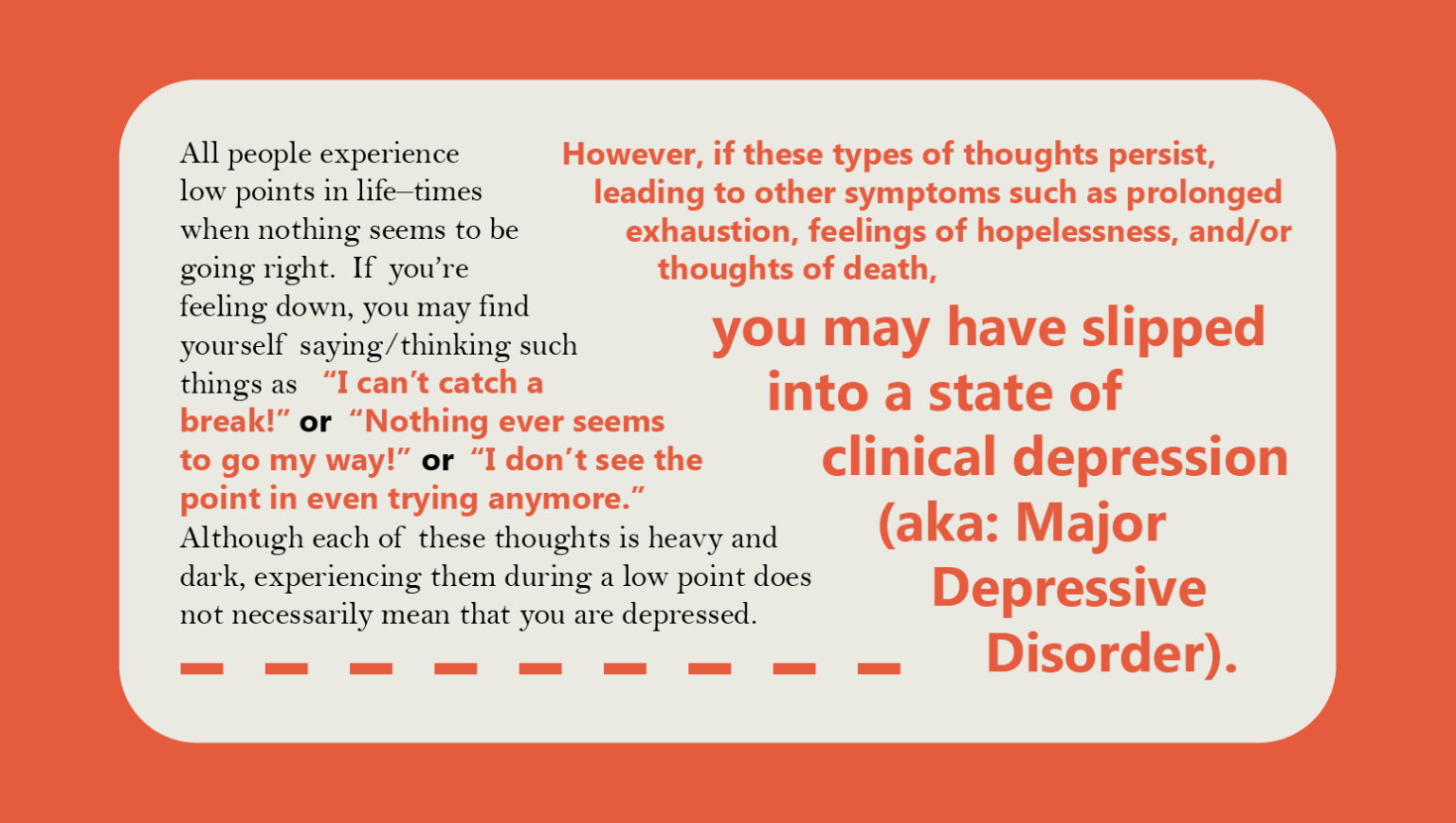
Major Depressive Disorder (MDD) is a mood disorder that can be diagnosed by a doctor or a professional mental health practitioner. Someone suffering from MDD experiences persistent feelings of sadness and a loss of interest in activities that typically bring a sense of joy. Major Depressive Disorder can impact one’s mental state (thoughts), emotional state (feelings), and physical state (behavior).

Depression can be a major obstacle to one’s ability to live a productive life. When suffering from depression, everyday activities and responsibilities can feel overwhelming, impossible, and/or even pointless, leading one to ask questions such as “Would everyone be better off without me around?” or “Is this life even worth living?” or “Should I just kill myself?” If you or someone you know is asking themselves these types of questions, it’s time for serious help right now!
We at Stone Labyrinth Counseling & Wellness can help! If you think that you may be experiencing depression, please reach out to schedule an appointment.
You are never alone! If it’s after hours and you are questioning whether life is worth living anymore, please do the following right away:
Call/Text 988: The Suicide and Crisis Lifeline
988 is a free nationwide hotline, which provides confidential support via phone call, text, and/or live chat.
What is Depression?
Clinical depression or Major Depressive Disorder is a serious mental health condition that results in negative, dark, heavy, and/or problematic thoughts, emotions, and behaviors. Unlike general sadness, depression symptoms persist over lengthy periods of time–two weeks or longer, months, or even years.
Furthermore, depression becomes an obstacle to a person’s ability to live life effectively on a daily basis: execute day-to-day responsibilities, experience joy, sleep regularly, eat regularly, maintain healthy relationships. Left untreated, or inadequately treated, depression can escalate to serious impairment, other health-related issues, and even suicide.
FAQs: Basics
What are the signs of depression?
- According to the DSM-V, a doctor or professional mental healthcare provider can diagnose a person with Major Depressive Disorder (MDD) when the person experiences at least five of the following symptoms for two consecutive weeks, or more:
- Depressed mood–persistant for most days.
- Significantly reduced pleasure or interest in typically enjoyed activities–persistant for most days.
- Increase or decrease in appetite, leading to sudden weight gain or loss.
- Significant changes in sleeping pattern–restless sleep or prolonged sleep.
- Persistent fatigue or lack of energy.
- Increased restlessness, fidgeting, or irritability.
- Elevated levels of anxiety.
- Persistent feelings of overwhelm, helplessness, hopelessness, or worthlessness.
- Difficulty thinking, concentrating, focusing, or making decisions.
- Thoughts of death or suicide.
What causes depression?
- It is commonly misunderstood that depression is simply a “chemical imbalance in the brain.” The fact of the matter is that depression is a complex mental illness that stems from a variety of circumstances, including the following: faulty mood regulation, genetics, and environmental circumstances. Like most things in life, depression cannot be accurately traced back to one single cause.
- In an effort to keep it as simple as possible, it is important to understand that depression is a mental illness–having to do with the brain, and how its biology interacts with genetic and environmental factors. Being that we are all unique, coming from different biological and environmental backgrounds, it is also clear to see that what causes depression in one person will likely differ from what causes depression in another. For these reasons, it is important to seek professional help if you, or someone you know, is experiencing symptoms of depression.
- If you think that you, or someone you know, may fit these criterion, please reach out for support. We at Stone Labyrinth Counseling & Wellness can help you! If you feel that you are in need of urgent help, please do not hesitate to call/text 988, the free National Suicide and Crisis Lifeline.
How is depression diagnosed?
- Please read the answer to the question, “What are the signs of depression?” above. It is important to note that any diagnosis is made by a professional mental healthcare provider or doctor. If you think that you, or someone you know, is suffering from depression, please contact a professional right away. We at Stone Labyrinth Counseling & Wellness can help!
Is depression genetic?
Please read the answer to the question, “What causes depression?” above. Although genetics likely does play a role, it is unlikely that genetics is the only reason one may be suffering from depression, or any other mood disorder for that matter.
FAQs: Next Steps
How do I know if I am depressed?
Please read the answers to the questions above. For a professional assessment of your mental health, please reach out to us at Stone Labyrinth Counseling & Wellness.
Is depression treatable?
- Absolutely! Yes, depression is treatable. Most commonly, depression is treated by a mental healthcare provider (e.g.: counselor, therapist, social worker) and/or a medical professional who can prescribe medications (e.g.: doctor, psychiatrist, nurse practitioner). Although both forms of treatment are effective, research suggests that in more serious cases, a combination of both–talk therapy along with medicinal therapy–is the most effective treatment for depression.
- In the most severe and rare cases, other forms of treatment have shown effective. Special brain procedures such as Transcranial Magnetic Stimulation (TMS) and Electroconvulsive Therapy (ECT) do exist. These more specialized modes of treatment could be considered after talk therapy and medicinal therapy have proven ineffective.
Can I live with depression?
- Yes! You are not alone! According to a 2025 article out of Temple University, and a 2025 data brief from the U.S. Centers for Disease Control and Preventions (CDC), “more than 1 in 8 Americans aged 12 and older have experienced symptoms of depression.” Along with General Anxiety Disorder, Major Depressive Disorder, make up the two most common mental health conditions amongst U.S. citizens.
- Some helpful steps to take if you are living with depression:
- Reduce screen time–Specifically speaking, reduce social media exposure and screen time prior to going to bed. Doing so will foster better sleep, helping the mind, body, and spirit recover more thoroughly.
- Exercise–Regular bodily movement promotes the production of natural hormones such as dopamine and serotonin, and it increases the production of endorphins. Together, these lead to elevated energy and increased motivation.
- Go outside–Exposure to natural light has been positively connected to a reduction in stress and an elevation in mood. Adding a short walk (exercise) can enhance the positive effects even more.
- Connect with others–Socialization is a basic fundamental need for human beings. Connecting with others is said to be one of the most effective ways to combat the negative effects of depression.
- Make an effort to talk with a friend(s).
- Volunteer
- Join a community/school group
- Join a team
- Create routine–A regular routine is the equivalent to balance and consistency. Structure and healthy habits promote mental health.
- Avoid alcohol and substance abuse–Substances such as these can deepen feelings of depression. Additionally, they can interfere with medications used to treat depression.
Is depression preventable?
Depression is not fully preventable. Again, as stated above, depression is a complex condition brought on by a unique variety of chemicals in the brain, genetics, and environmental circumstances. All of that being said, we can take a multitude of actions that all contribute to a healthier lifestyle and overall mental health and wellness. Please read the answer to the question, “Can I live with depression?” above for more detailed information on how we can live without depression.
 English