Parental Stress
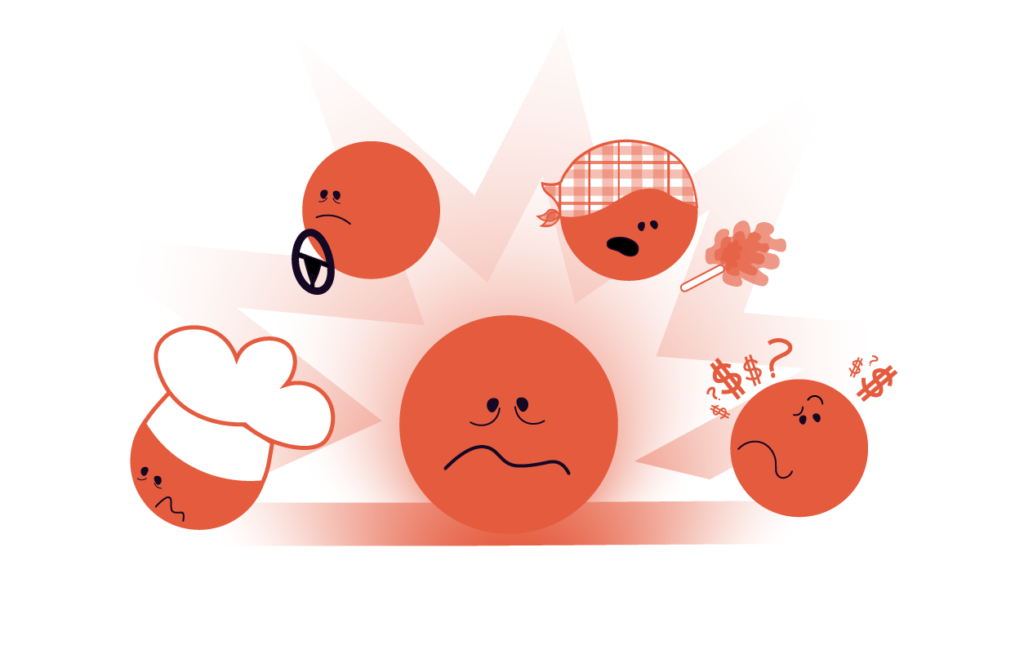
Do you feel as though you exist just to run around and put out fires? Do you often feel like an Uber driver, house keeper, chef, accountant for your child or children?
Let us guess, by the time you have a moment for yourself, you’re too exhausted to actually take it. So what’s the result:
- Feeling disconnected from spouse
- Doom scrolling late into the evening
- Absence of social life–enjoyment
- Lack of quality sleep
- Increased agitation & anger
- Elevated voices
- Influx of arguments
- Poor or ineffective communication
FAQs on screens:
How do I get my child to get off their phone and engage with the family?
Boundaries! Boundaries! Boundaries! If you think about it for just a second, you will recognize that we allot a certain amount of time throughout the day for certain things (e.g.: meals, showers, getting ready, driving to work, the actual work day, extracurricular practices, athletic games, sleep). Each of these activities has what we consider an appropriate amount of time allocated to them. For example, “Can we please put an end to the 30-minute hot shower!?”
Okay, in the same way, we get to allot a certain amount of time in the day for phone usage. Also, we get to deem certain blocks of time in the day “phone-free” times. Even more, we get to deem certain events (e.g.: meals, showers, studying, car rides) “phone-free” events.
Structure is always great, so having a specific place for the phone during these blocks of time and events is important. For example, during dinner time, everyone’s phone gets put on silent in their bedroom. Or while driving, phones get put on silent and go in the purse/backpack/bag/glove compartment.
When is an appropriate time for my child to put their phone away for the night?
This depends on the age of your child; however, a healthy general rule is one hour prior to bed time. Now, we will benefit from a few clear cut definitions here:
-
- Bedtime: The time at which your child retires to their room for the evening? Ideally, nine hours prior to having to wake up in the morning.
-
- Away: On a charging station outside of your child’s bedroom.
-
- Charging Station: The place in the house (outside of any bedrooms) where everyone charges their phones.
What is an appropriate daily average screen time for my child?
To answer this question, we have to be clear about how we define “screen time.” Are we talking just phone screens? What about computer screens? TV screens? Gaming screens? Unfortunately, our lives are often governed by screens, so cutting “screen time” can be tricky.
For the sake of answering this question, let’s just assume that we’re talking about phone screens and/or gaming screens. Once again, boundaries are essential! Here are a couple of boundaries to consider:
- Screen time ought not exceed the amount of time spent studying once home from school.
- Screen time ought not exceed the amount of time spent at practice (extracurriculars).
- Screen time ought not exceed ¼ the amount of time you sleep on a typical weeknight.
Is it okay for my child to play video games multiple hours a day?
Please see “appropriate daily average screen time” above.
FAQs on personal life:
How do I regain control of my personal life?
Boundaries! Boundaries! Boundaries! It’s okay to say “no.” In fact, it is one of the healthiest, and most effective, forms of self-care. To regain control of your personal life, we encourage you to subscribe to what we call “Pillar 1.”
Pillar 1 is as follows. Repeat these words, “The pyramid of care begins with self-care.” If you were planning a road trip, you wouldn’t hit the road before you filled your gas tank, right? In life, it’s essential for us to do that, too–fuel your tank! And do so BEFORE investing your time and energy into taking care of anyone or anything else. This is how you begin to regain control over your personal life.
Just a few examples of self-care:
- Subscribe to “no” as a healthy response.
- Establish a daily consistent mindfulness practice.
- Subscribe to people & environments that promote laughter.
- Breathe with intention.
- Practice singular focus on purpose.
- Drive in silence.
- Schedule a hangout with a friend (put it on the calendar).
- Intentionally carve out time to read.
- Intentionally carve out time to move your body.
- Set clear boundaries.
- Schedule a game night with your family.
- Establish a clear threshold between work and home.
- Subscribe to weekly meditation.
- Schedule a date night with your partner.
- Schedule an appointment at Stone Labyrinth Counseling & Wellness.
How do I regain access to my social life now that I'm a parent?
Please see, “How do I regain control of my personal life?” above.
FAQs on partners:
How do my spouse and I regain our spark?
It’s common to want to “regain” or “recover” that which we “once had.” That said, “what we once had” led us to this point, which is likely an unwanted place. All of that being said, we want to encourage you to understand that change is not bad; it’s inevitable.
Wanting to go back to the way things used to be could actually be the very thing preventing you from enjoying all of the wonders of the present moment. Our encouragement is to work on identifying ways to ground yourself in the present moment because the present moment is always full of beauty, love, and reasons for gratitude–three of the main ingredients for living a happy, healthy life.
If you’d like help with this process, reach out to us here at Stone Labyrinth Counseling & Wellness, PLLC. Our team is ready to support you! Click HERE to contact us.
FAQs on behavior:
How do I get my child to contribute to the house (i.e. : How do I get them to do their chores)?
This can be done in a number of ways. Often the methodology depends on the age of your child. Two beliefs are fundamental to accomplishing this goal. And age is not an issue. The beliefs are as follows: 1) My child has a tremendous amount of worth and value to offer our home. 2) I/We have more power than we often think.
The model is actually quite simple. Let’s aim to empower your child. The way you communicate with your child is crucially important. The days of taking things from your child are over, unless, of course, you’re interested in fighting with your child. If you want to fight, go ahead and keep taking things from them. If you want to live in peace, knowing that your child is contributing value to your home, empower them. How do you do that? Here’s how. One sentence can shift this whole dichotomy for your family.
- “Once you’re all done with (choose the contribution), you can use the (choose the luxury item) that we have lovingly provided you.”
- “If you choose not to (fill in the contribution), please just know that you are simultaneously choosing to sacrifice (fill in the luxury item) for the next two days.”
- Example contributions:
– dishes, picking up their room, doing their laundry, folding & putting away laundry neatly, mowing the lawn, vacuuming, dusting, preparing dinner for the family, making their lunch, taking a shower, brushing their teeth, picking out an outfit for themselves, getting the oil changed in the car, doing their homework
- Example luxury items:
– phone, ipad, tablet, gaming console, screen time, apps, headphones, extracurricular school events, time with friends, sleepovers, athletic practice, athletic games, the car.
How do I say "no" to my child?
Simple! Just like this–“No.”
- Often saying “no” to our child is so much less about the word “no” and so much more about what happens inside of us as parents when we let that word travel past our lips. That said, saying “no” becomes much simpler when we recognize that it is our own “stuff” that begins to boil up inside of us when we say that coveted word that we all wish we could say without so much ache and intrinsic turmoil.
- Let’s face it, it’s not the word “no” that is the issue here. The issue occurs the moment our child begins to react indignantly to our saying “no” to something they want. Now, this opens up a bag of items that likely need sorting.
- For example, what is the reason our children believe they “get to”? I mean, they know to ask permission; therefore, they must know that “no” is a potential answer. Why, then, do they so often morph into a monster upon hearing that answer?
-
- For example, what is the reason we as parents tend to react so negatively (AKA: angrily) to our child’s morphing into a monster in the moment of “no”? Well, anger is a secondary emotion that we often employ as a defense mechanism–not against our children, but against that ache and/or intrinsic turmoil that begins to boil up inside of us upon the monster morphing. Schedule an appointment. Let’s talk more about it.
My adolescent doesn't want anything to do with me. What do I do?
First and foremost, let’s understand the fact that adolescence is an extremely challenging phase of life. Your adolescent is currently operating with half a brain. Two quick things about that:
- It’s not their fault. They’re literally developing.
- The best part is yet to come.
Our brains develop into the early to mid twenties, and the last phase of development focuses on the prefrontal cortex, which is responsible for all of our reasoning, logic, personality expression, decision making, and moderating social behavior. All of that being said, your child quite literally may not know how to interact with you at this stage of their life. And again, it’s not their fault.
By the way, it’s not your fault either. Our children will go as we go. The single best thing we can do to help our adolescent children is to prioritize our own self-care. When we do that, we arm ourselves with all that’s needed to create and maintain a warm, safe, loving, and supportive environment in which our children can naturally develop into the healthy, happy young adults we want them to be. Remember, it’s not our job to create them into that. Rather, it is our job to create an environment that is conducive to the natural development of our children.
Lastly, when we prioritize our own self-care, we increase the likelihood of showing up to our fullest capacity. That means that we are fully prepared to model healthy relationships for our developing adolescents. So, long story short–what do you do about it? Love yourself, so that you can show up for them.
 English